
Thoughts on Data Mining and the BoC Database

While head of S&P Global sovereign ratings, I published a number of reports on defaults by both rated and unrated sovereigns between 1994 and 2006. Initially, I hoped to do updates on a regular basis (and at least annually), but my other responsibilities often got in the way. Besides, the project was not easy to delegate. While my colleagues came to appreciate the work I was doing, including its franchise value, very few were willing to share this work with me, or take it over. When I moved to Bank of Canada, I had no such difficulty and have been belessed with two excellent collaborators — first Jean-Sébastien Nadeau and now Jamshid Mavalwalla. I’ll come back to this issue a little later.

In between the S&P updates, I sometimes heard from readers asking where they might get the data ahead of the next published report. My answer, that the data had to be mined from multiple sources, as often as not caused great surprise and occasionally even consternation. Surely, many readers supposed, an organisation like the International Monetary Fund must collect this data. This seems a reasonable supposition, then as now, and certainly at a country level the IMF is aware of its members that have obligations in default. (Staff awareness of defaults by non-members may be another matter.)

Still, the Fund has never published data of the kind that S&P did. Nor has it sought to launch a database on the scale of the one housed in the Bank of Canada’s sovereign default database. It is not difficult to see why. The simple truth is that the IMF has a conflict of interest. It lends to sovereigns and, together with a number of multilateral development banks, has carved out a position as a preferred creditor relative to other official and private creditors. At the same time, no member state would welcome being labeled a defaulter by the IMF. Nor would the Fund want to be drawn into a debate with its members on what actually constitutes a sovereign default.

Unsurprisingly, our examination of hundreds of programme documents shows that the Fund often does shy away from using the highly charged term when discussing individual sovereigns. It may refer to a “payment default” when such an event involves a foreign currency bond, but with other obligations, notably loans by official creditors, it usually refers to payment defaults as “arrears” even though they, too, are contractual obligations. It’s a similar story with defaults on local currency debt. For example, in a 2007 report on Nicaragua, Fund authors refer to the sovereign’s “inability to service scheduled debt repayments that came due in January 2005––they were ultimately serviced in June and in November 2005…”

Standard & Poor’s, on the other hand, faces no such conflict./1 Its credit ratings are intended to reflect the credit rating agency’s (CRA) view of the likelihood of default, and that definition of default is applied in the same way to public and private obligors. As readers of Technical Paper 101 published annually between 2014 and 2017, and this year’s staff working paper published jointly by the Bank of Canada and the Bank of England, my current employer, will know, the way we define sovereign default draws on the definition that S&P (along with most other CRAs) employs. We simply apply the same definition to debt owed to official creditors, which CRAs generally do not rate.

1/ Of course I’m referring here, narrowly, to the CRAs’ lack of a conflict of interest in identifying debt defaults. Clearly, CRAs face other conflicts of interest in their businesses but these are outside the scope of our research on sovereign defaults.
How Frequently Do Sovereigns Default on Local Currency Debt?

presentation1

(This is an updated version of a note originally posted on LinkedIn in November 2016.)

A long-held view by some investors is that governments rarely default on local or domestic currency sovereign debt.[1] After all, they say, governments can service these obligations by printing money, which in turn can reduce the real burden of debt through inflation and dramatically so in cases like Germany in the 1923 and Yugoslavia in 1993-94.

Of course, it’s true that high inflation can be a form of de facto default on local currency debt. Still, contractual defaults and restructurings occur and are more common than is often supposed. A key objective of our ongoing work compiling and updating the Bank of Canada’s sovereign default database (available at http://www.bankofcanada.ca/2014/02/technical-report-101/) is to identify and document such cases for 1960 – 2016, the timeframe covered by the 2017 vintage of the database released on 30 June 2017.

We’ve previously highlighted that documenting local currency defaults is challenging because they are rarely acknowledged as such by the governments concerned. But there is another factor that has likely contributed to the reduced visibility of many local currency defaults – the investors affected were (and are) mostly domestic residents with limited avenues of redress. Cross-border investment in sovereign local currency debt instruments, a phenomenon dating back to the 1990s, has contributed to broader awareness of more recent default cases.

So far, we have identified 27 sovereigns involved in local currency defaults between 1960 and 2016. These defaults have taken different forms. Perhaps most surprising is the number involving demonetisations of central bank notes on confiscatory terms. We reckon that 17 sovereigns have undertaken such exchanges, with some (e.g. USSR/Russia, Myanmar, North Korea and Ghana) doing so more than once. Losses occurred when mandated exchanges of bank notes occurred over short periods, when they placed limits on the amounts of old notes that could be exchanged for new notes, when excess notes were required to be deposited in blocked accounts, and when foreign holders of banknotes were prohibited from participating in the exchanges.

Confiscatory currency reforms appear to be idiosyncratic in nature – often the result of regime changes and/or efforts by centrally planned governments to curb black markets. In most cases, domestic capital markets were either underdeveloped or non-existent, and so bank note exchanges were not always an indicator of broader fiscal distress. Indeed, among these 17 sovereigns so far we have identified just two cases (Nicaragua and Russia) where the government defaulted on other types of local currency default, although many more ultimately defaulted on foreign currency obligations owed to official and private creditors. The local currency defaults involving nine other sovereigns included arrears on scheduled interest and principal payments, restructurings of maturities, unilateral reductions in real interest coupons and maturity extensions on inflation-linked debt, and the imposition of taxes targeting local currency debt service.

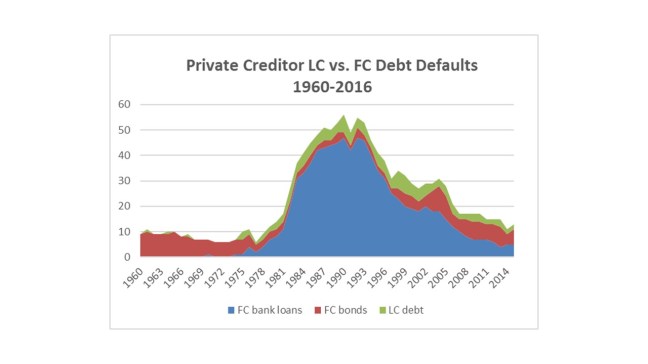
The chart above tracks the annual number of defaults on local currency debt we’ve identified compared with defaults on foreign currency bank loans and bonds, the two other main categories of sovereign debt owed to private creditors. Over nearly half the survey period, defaults on foreign currency bank loans predominated. But in the past twenty-five years, as banks pulled back from sovereign lending, defaults on foreign currency bonds have increased, as have, to a lesser extent, defaults on local currency debt. In the past decade, between 4 and 8 sovereigns per year have been in default on foreign currency bonds, and between two and three sovereigns per year for local currency debt.

Interestingly, defaults on foreign and local currency debt by the same sovereign have happened concurrently less than half of the time. Looking ahead, though, debt dynamics may be shifting. With public debt burdens of many advanced and emerging sovereigns increasing at the same time as cross-border investment, defaults on local currency debt could become more frequent and as common as defaults on foreign currency bonds. In the meantime, though, there is one caveat. And that is that our understanding of the past may need to be revised if and when more historical local currency defaults are identified.[2]

We’ll continue to keep you posted on our work ahead of publishing the next vintage of the sovereign default database in 2018.

[1] Local or domestic currency debt refers here to obligations issued by a government in its own currency. For sovereigns that are members of monetary unions, debt denominated in the common currency is regarded as foreign currency debt in our analysis.

[2] Our efforts to identify local currency defaults currently focus on securitized debt. In other words, we exclude some types of domestic fiscal arrears — unpaid supplier invoices, salaries, and pensions — even though, when lawfully contracted, they too are government obligations. With that in mind, we are considering including them in future updates of the sovereign default database.


2017 Bank of Canada Sovereign Default Database Published (Sort of)!

NASA2MapCRAGDatabase2017-06-29

r101-revised-june2017

The good new is that the 2017 update of Jamshid Mavalwalla’s and my technical paper has been published. But we discovered last night that the link to download the database itself doesn’t work!

Hopefully, the IT folks at the BoC will sort this out on Monday. Meantime, readers of this blog and folks on LinkedIn can download both the database excel file and the technical paper from the links above.

About me and this blog

I’m a UK-based economist and credit analyst. A focus throughout my professional career — which has spanned work at non-profits, central banks, investment banks and a 20+ year stint at S&P Global — is the credit standing of governments.

While working at the Bank of Canada in 2012-13, my colleagues and I developed a unique database of defaults by sovereigns on debt owed to official and private creditors. You can download the 2023 vintage of what is now known as the Bank of Canada (BoC) – Bank of England (BoE) Sovereign Default Database and our associated research from:

https://www.bankofcanada.ca/2023/07/staff-analytical-note-2023-10/ and https://www.bankofengland.co.uk/statistics/research-datasets.

Since returning to the UK in 2014–where I worked at the Bank of England, retiring in 2021–I’ve continued to collaborate with BoC and BoE staff to further develop the database.

Why is the BoC-BoE sovereign default database unique? Because it is the only database in the public domain that captures all types of sovereign debt in default owed to public and private sector creditors. Previous databases, including one I intermittently published between 1994 and 2006 while at S&P, mostly focused on foreign currency bank loans and foreign and local currency bonds. None pulled together data on the various types of public creditor claims in default. And none provided data on governments’ domestic arrears. Ours does this both on a country and global basis, with amounts calculated in current U.S. dollars, for the years 1960 though 2023.

In this blog I’ll discuss this ongoing project and what I’ve learned, and am still learning, about the dynamics driving sovereign defaults.